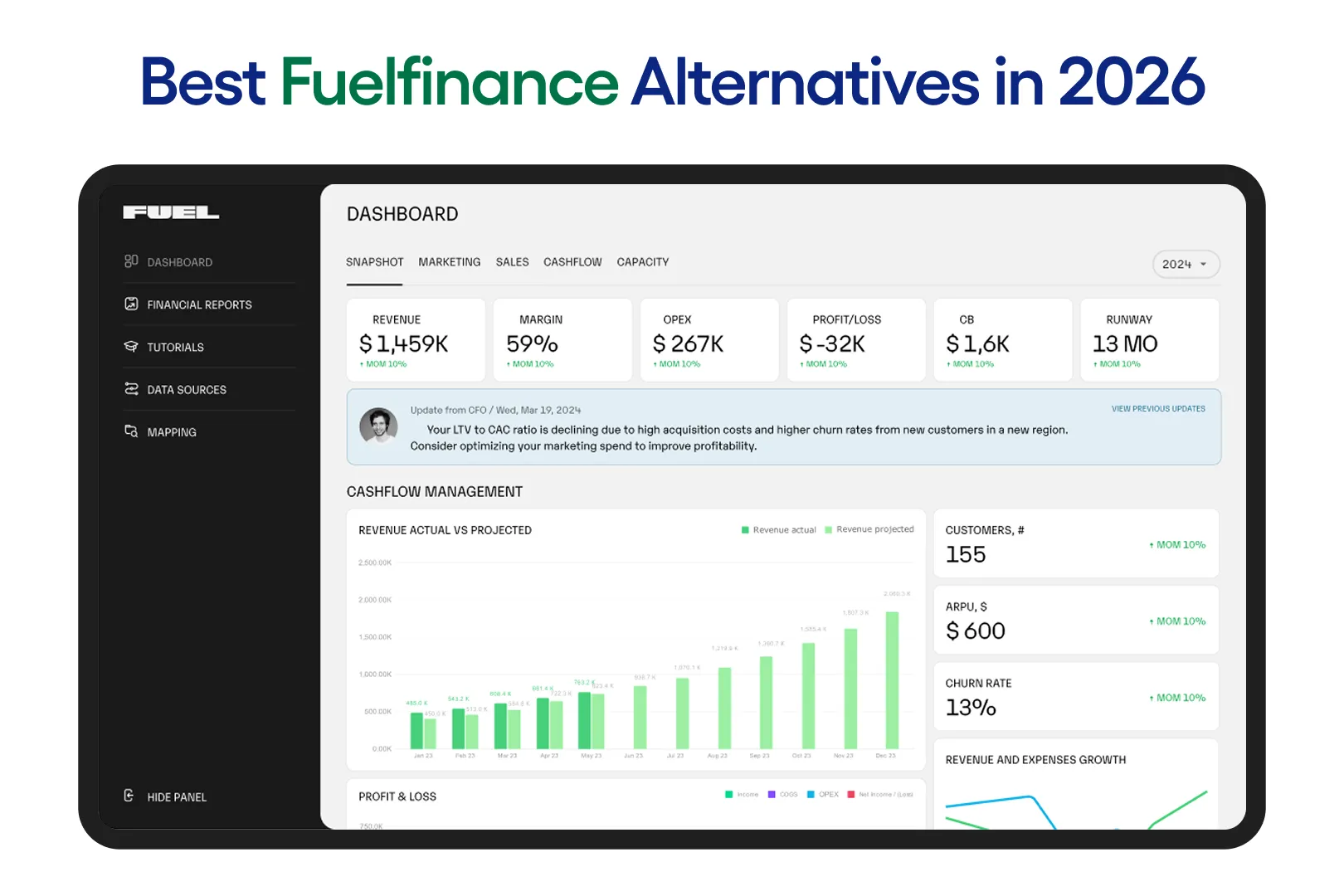
Fuelfinance is a financial planning platform for startups and small businesses. It combines AI forecasting with a dedicated financial manager, which makes it useful for founders who need financial visibility without hiring a full-time CFO. That said, three clear reasons lead people to look elsewhere: the starting price of $1,199+ per month is a meaningful commitment for an early-stage business, the managed service model does not suit everyone who prefers self-serve financial planning and analytics (FP&A) software, and Fuelfinance is built specifically for digital businesses rather than physical ones.
This page compares 7 Fuelfinance alternatives across those three reasons. These alternatives are for startups, agencies, and digital businesses looking for a different FP&A tool. One also caters to physical business owners like restaurants, salons, gyms, and retail shops, who need financial and operational data combined, which Fuelfinance is not built to deliver. Each alternative is reviewed on what it does, who it is best for, and what it does not do.
For context: Fuelfinance is a cloud-based FP&A platform with AI forecasting, budget vs actual tracking, scenario planning, and a dedicated financial manager included in the subscription. Pricing is quote-based, but industry insights confirm it starts from $1,199 per month. It is built for startup founders and SMB owners without a finance background.
Fuelfinance Alternatives, At A Glance
Here is a quick summary before the full review of each alternative.
| Tool | Main Focus | Human Team Included | Best For | Biggest Limitation | Starting Price |
| Miivo | Physical business BI | Yes✅ | Physical businesses, Multi-location businesses | Not an FP&A platform | From $399/month |
| Mosaic (now acquired by HiBob) | AI FP&A | No | SaaS and growth companies with finance team | Enterprise pricing | Custom quote |
| Pry (now Brex) | Cash runway + FP&A | No | Pre-Series A startups | Limited depth | From $12/user/month + add-on charges |
| LiveFlow | Spreadsheet sync | No | Finance pros, accountants | Spreadsheet-dependent | Custom quote, ranges from $200 – 1,500+/month |
| Runway Financial | Visual cash modeling | No | Seed-Series B startups | Pricing opaque | quote-based |
| Jirav | Mid-market FP&A | No | $10M-$100M businesses | Complex setup | From $10,000/year |
| Float | Cash flow forecasting | No | Service businesses, agencies | Cash focus only | From $130/month |
Miivo: Business Intelligence Plus a Human Team, Built for Physical Businesses
What Miivo Is
Miivo is a business intelligence service with a dedicated human team for physical businesses. Like Fuelfinance, the BI tool combines software with a team that handles setup and interpretation. Unlike Fuelfinance, it connects operational data from the POS alongside financial data from accounting, which gives a physical business a complete daily view of what is actually happening across both sides of the operation.
Best For
Restaurant owners, salon groups, gym operators, and retail businesses who want financial and operational data combined automatically, with a human team handling setup and interpretation. No finance background required.
What Miivo Does Well
- Miivo joins financial data from accounting, POS data (covers, average spend, product performance), and customer review data into one automatic daily dashboard.
- AI Warning Signals flag when something changes before it shows up in your accounting software.
- Opportunity Cards surface specific actions with an estimated revenue impact.
- A dedicated human team handles all setup and maintenance.
- Live in 5 business days.
- Pricing is published and fixed.
What Miivo Does Not Do
Miivo is not an FP&A platform. It does not do scenario planning, forecasting, or startup runway modeling in the Fuelfinance sense. It is not ideal for SaaS companies, agencies, or digital businesses but is suitable if the business has a physical location.
Pricing: Free Ready To Use with no credit card requirement, Built For You at $399/month. Managed Services at $1,299/month. Setup included.
What Makes Miivo Stand Out?
Every alternative on this list except Miivo is built mainly for digital businesses. If you run a restaurant, salon, gym, or retail shop, the tools below will not connect to your POS, will not show you covers or average spend, and will not tell you why a Tuesday in March performed differently from the one before it. Fuelfinance has the same limitation. The alternative built for physical businesses is Miivo.
See how Miivo works for physical businesses
Mosaic: AI-Powered FP&A for SaaS and Growth-Stage Businesses
What Mosaic Is
Mosaic is an AI-powered FP&A platform built for SaaS and growth-stage businesses, now acquired by HiBob. It connects with accounting software (QuickBooks, NetSuite), CRM platforms (Salesforce, HubSpot), HRIS tools, and billing systems to build a unified financial model. The platform surfaces SaaS-specific metrics, like ARR (Annual Recurring Revenue), churn, CAC (Customer Acquisition Cost), and LTV (Customer Lifetime Value), automatically, without requiring manual data entry from your finance team.
Best For
SaaS companies and growth-stage startups with a finance team or CFO who want automated financial modeling and AI-powered anomaly detection. Works best for businesses in the $5M to $50M ARR range that have outgrown spreadsheets but do not yet need enterprise software.
What Mosaic Does Well
- Handles SaaS-specific financial metrics better than most FP&A tools.
- AI-powered insights and anomaly detection flag changes in real time.
- Headcount planning is built in, which matters for teams managing hiring against a financial model.
- The interface is modern and well-reviewed by finance leaders at growth-stage companies.
What Mosaic Does Not Do
Mosaic does not include a dedicated human financial manager. It is fully self-serve, which means that the finance team builds and maintains its own models. It is not built for physical businesses. Pricing sits in the enterprise range, which makes it a difficult fit for early-stage startups watching costs closely.
Pricing: Custom pricing, not published. Typically $1,000 to $3,000+ per month for growth-stage companies. Demo required.
Is Mosaic Worth It for an Early-Stage Startup?
Not usually, as Mosaic is priced and designed for companies with a finance team already in place. If you are pre-Series A without a dedicated CFO or financial analyst, you need more practical starting points.
Pry (Now Brex): Cash Runway and FP&A for Early-Stage Startups
What Pry Is
Pry is a financial planning platform for early-stage startups, now part of Brex. It covers budget vs actual tracking, cash runway, hiring plan modeling, and scenario planning. The platform integrates with QuickBooks, Xero, Gusto, and Brex spend management. The tool is designed for founders who need financial visibility without a dedicated finance person.
Best For
Pre-revenue to Series A startups and early-stage founders who need to track cash runway, manage headcount forecasting, and run basic scenario planning. Works well as a first step beyond spreadsheets for teams without a full-time finance hire.
What Pry Does Well
- Budget vs actual tracking updates automatically with bank sync.
- Cash runway projections are visual and easy to read.
- The hiring plan tracks headcount and fully loaded employee costs, which is useful when modeling the impact of new hires on runway.
- Scenario planning is accessible.
- Pricing is significantly lower than Fuelfinance.
What Pry Does Not Do
Pry does not include a dedicated human financial manager. it is self-serve. The depth of financial modeling is lighter than Fuelfinance or Mosaic, which makes it better suited to simpler business models. Physical business data (POS, bookings, operational metrics) is not supported.
Pricing: Free plan available as Essesntials. Paid Premium plan starts from $12/user/month, while Enterprise plan is custom.
Pry vs Fuelfinance: What Changes?
The main trade-off is human support vs cost. Fuelfinance includes a dedicated financial manager, Pry does not. If the fractional CFO model is what you need, Pry will not replace it. If you want a self-serve tool at a lower price point, Pry covers the core FP&A functions for early-stage businesses.
LiveFlow: FP&A That Stays Inside Google Sheets and Excel
What LiveFlow Is
LiveFlow is a Google Sheets and Excel-based FP&A tool that automatically syncs accounting data from QuickBooks, Xero, and NetSuite into existing spreadsheet models. It removes the manual copy-paste step between accounting software and your financial models, which keeps spreadsheets live without rebuilding them.
Best For
Finance professionals and accountants who work mostly in Google Sheets or Excel and want to keep that workflow while automating data sync from accounting software. Also works well for agencies and advisory firms that manage multiple clients from a single spreadsheet setup.
What LiveFlow Does Well
- LiveFlow stays inside Google Sheets and Excel.
- There is no new interface to learn.
- Automatic data sync removes the manual update cycle from financial reporting.
- Multi-client management makes it practical for accounting firms and agencies that run consolidated reporting across several entities.
What LiveFlow Does Not Do
LiveFlow requires comfort with spreadsheets. It is not a dashboard-first product and does not suit users who want a purpose-built FP&A interface. There is no dedicated human financial manager too. Physical business data is not supported.
Pricing: Custom pricing, after booking demo. According to industry data pricing typically starts from $200 to $1,500+ per month for enterprise level.
Who Should Not Use LiveFlow?
Anyone who wants to move away from spreadsheets entirely. LiveFlow is a tool that helps with the spreadsheet workflow; it does not replace it. If the reason you are looking for a Fuelfinance alternative is that your current process is too spreadsheet-heavy, LiveFlow will not solve that.
Runway Financial: Visual Cash Flow Modeling for Startup Founders
What Runway Financial Is
Runway Financial is a financial planning and scenario modeling platform with a strong visual interface. It connects with QuickBooks, Stripe, Gusto, and other common startup tools to build a financial model that displays as a timeline instead of a spreadsheet. The platform focuses on cash flow modeling, hiring plans, and scenario planning for growth-stage businesses.
Best For
Seed to Series B startups and growth companies that want visual cash flow modeling and scenario planning with a modern interface. Suitable for founders who prefer to see their financial model as a timeline and want AI-powered insights built into that view.
What Runway Financial Does Well
- The visual interface makes complex financial models accessible to founders without a finance background.
- Scenario planning updates in real time across dashboards.
- Integrations with common startup tools (Stripe, Gusto, QuickBooks) work well for digital businesses with a standard stack.
- AI-powered insights surface anomalies automatically.
What Runway Financial Does Not Do
Runway Financial does not include a dedicated human financial manager and is self-serve. Depth of financial modeling is less than enterprise-grade FP&A tools. Pricing is not published, which makes it harder to evaluate without going through a demo.
Pricing: Custom. Demo required. Estimated mid-hundreds per month for startups.
Is Runway Financial the Right Fit for Your Stage and Budget?
Runway Financial works well when your main job is modeling growth for investors. It does not fit as smoothly when you run a local business that needs daily operational insights instead of funding scenarios.
Jirav: FP&A for Mid-Market and Professional Services Businesses
What Jirav Is
Jirav is an FP&A platform for mid-market and professional services companies. The finance tool combines financial and operational data, supports headcount planning, multi-entity consolidation, and board reporting. The platform integrates with NetSuite, QuickBooks, Salesforce, and other platforms used by businesses in the $10M to $100M revenue range.
Best For
Professional services firms, agencies, and mid-market companies that need multi-entity financial consolidation and operational data combined with financial planning. Works best for businesses that have outgrown early-stage tools and need board-ready reporting across multiple departments or legal entities.
What Jirav Does Well
- Multi-entity consolidation is Jirav’s biggest selling point for businesses with complex legal structures or multiple departments.
- Operational and financial data are modeled together.
- Headcount planning is built in and detailed.
- Board-ready reporting templates reduce the time spent formatting financial presentations.
What Jirav Does Not Do
Jirav is more complex and more expensive than early-stage tools. It typically requires onboarding support to set up correctly. There is no dedicated ongoing human financial manager. Physical business operational data is not natively supported.
Pricing: Custom. Not published. Typically starts from $10,000+ annually.
What’s Different Between Jirav and Fuelfinance?
Fuelfinance is designed for founders without a finance background who need their first layer of financial visibility. Jirav is designed for businesses that already have a finance function and need to manage more complex reporting. The two tools serve different stages of the same growth path.
Float: Cash Flow Forecasting, and Nothing Else
What Float Is
Float is a cash flow forecasting tool that connects directly with QuickBooks, Xero, and FreeAgent to build an automated cash flow forecast. Its single focus is showing how much cash the business will have and when. The tool does not attempt to be a full FP&A platform.
Best For
Service businesses, agencies, and small businesses that need to forecast their cash position week by week, manage client payment timing, and avoid cash flow surprises. Works well as a focused add-on alongside an accounting tool for businesses that do not need scenario planning or headcount modeling.
What Float Does Well
- Float builds an automatic cash flow forecast directly from accounting data.
- Scenario modeling for cash is practical: it shows what happens if a client pays late, if a large invoice lands early, or if a recurring cost increases.
- The interface is visual and easy to read.
- Pricing is affordable compared to full FP&A platforms.
What Float Does Not Do
Float is a cash flow forecasting tool only, it does not do P&L planning, headcount modeling, or scenario planning beyond cash. There is no human advisor included. Physical business operational data is not supported.
Pricing: Pricing available in GBP, USD, AUD, and EUR. Starter Essentials plan costs $130/month. Growth plan costs $265/month, while Scale plan starts from $389/month. Annual discounts available.
Is Float the Right Cash Flow Tool for Your Business?
Float earns its place on this list for one specific situation: a service business or agency that invoices on net terms, manages irregular payment timing, and needs to know every day whether cash is going to be tight in the next few weeks. For that job, it is fast to set up, affordable, and genuinely useful. The moment the need expands to P&L planning, headcount modeling, or investor reporting, Float stops being enough. It is not a weakness of the tool, it is the product’s design.
Which Fuelfinance Alternative Is Right for Your Situation?
The following common situations clearly point to the need for specific tools.
- You are an early-stage startup founder who needs to track runway and plan headcount without hiring a finance person: Pry is the most accessible starting point, as it is affordable, integrates with QuickBooks and Xero, and covers the basics: budget vs actual, cash runway, and hiring plan modeling.
- You run a SaaS business with a finance team and need AI-powered financial modeling: Mosaic is the strongest option because it is built specifically for SaaS metrics and growth-stage financial planning, with good integrations across CRM, HRIS, and billing platforms.
- You work in Google Sheets or Excel and want to stop updating your models manually: LiveFlow is built for exactly this to keep your existing spreadsheet workflow while automating the data sync from accounting software. It removes the manual step without changing how you work.
- You need focused cash flow forecasting and not a full FP&A platform: Float is the most specialized option for this. It is simple, affordable, and does one thing well: showing how much cash the business will have and when.
- You run a physical business, such as a restaurant, salon, gym, or retail shop, and need financial and operational data combined automatically: Miivo is the only option on this list built for physical businesses. The Fuelfinance alternative connects POS data alongside financial data and includes a dedicated human team, without you requiring a finance background or technical setup.
Running a Physical Business and Looking for a Fuelfinance Alternative?
Book a 15-minute call and Miivo will connect to your data and show you what your financial and operational picture looks like inside the platform.
*No credit card. No commitment. See your data first.