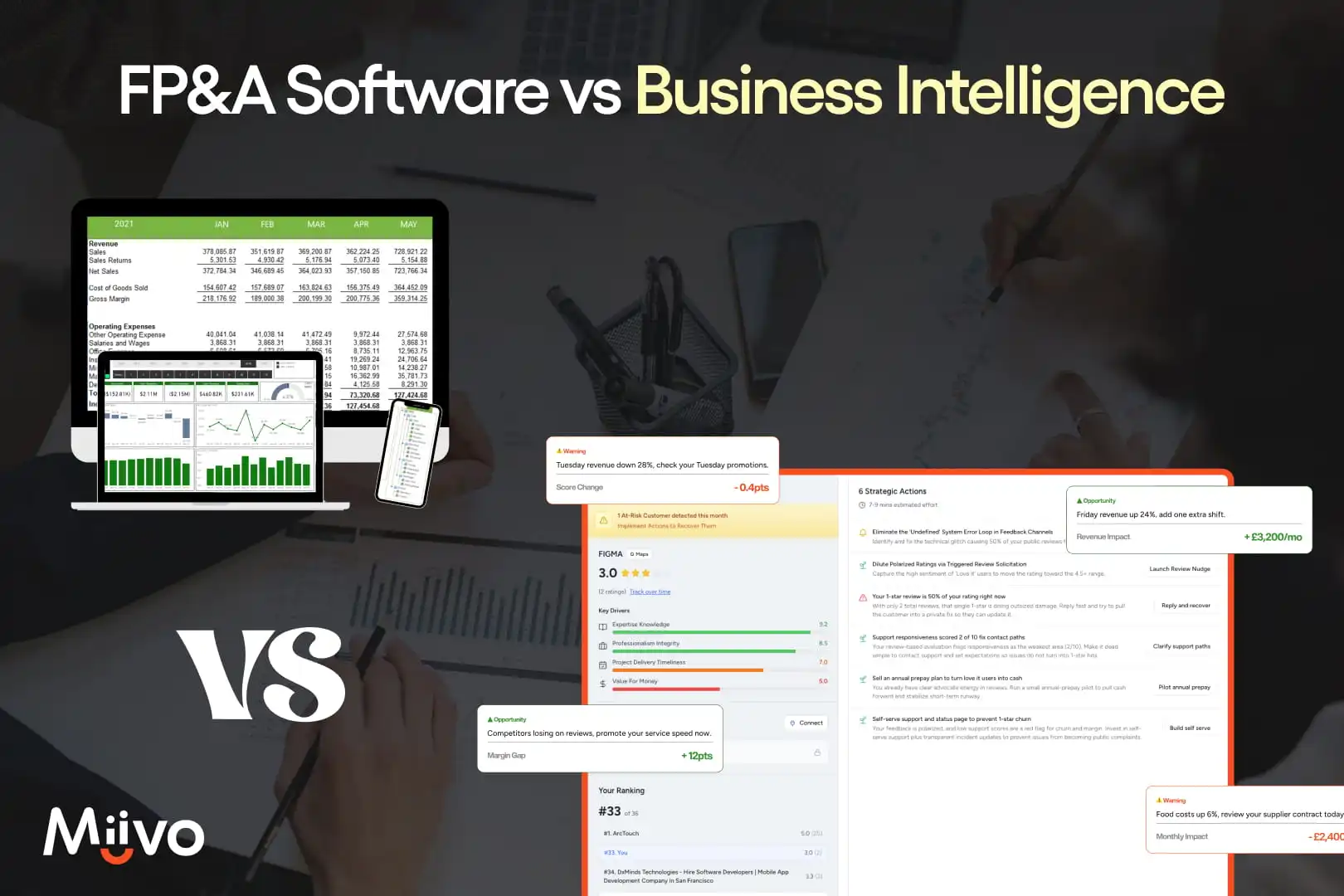
If you search for a comparison of FP&A software and business intelligence, most results are written by companies that sell FP&A tools. Their answer to the question ‘which one do you need?’ will always be FP&A, because that is what they are selling. This page is written from the other side. If you are a small business owner trying to understand whether you need FP&A, BI, or something else entirely, here is an honest breakdown.
This page explains what FP&A software actually does, what business intelligence actually does, where they overlap, and, most importantly, which one fits your business based on your size, your team, and what problem you are actually trying to solve. If you run a small physical business and have landed here after being confused by a software pitch, you will likely find your answer in the decision framework at the end.
What Is FP&A Software and Who Is It Built For?
Financial Planning and Analysis software helps finance teams plan, budget, forecast, and model different financial scenarios. It is forward-looking, the primary question FP&A answers is not ‘what happened’ but ‘what will happen if we do X.’ Examples include Anaplan, Planful, Workday Adaptive Planning, Oracle Hyperion, and Mosaic. These are tools built for CFOs, financial analysts, and finance managers, not for a business owner without a finance background.
FP&A helps finance teams with the following.
- Budgeting: building and managing formal annual budgets by department and entity.
- Forecasting: creating rolling financial forecasts that update as conditions change.
- Scenario modeling: running what-if analyses to see how different decisions would affect the business financially.
What Kind of Business Actually Needs FP&A Software?
FP&A software makes sense for a business that has at least one dedicated finance person and has outgrown spreadsheets for budgeting and forecasting. Most commonly, this means mid-market companies with a finance team, a CFO, or a controller who needs to build multi-year financial models and collaborate on budget approvals across departments. For most companies under $5 million in revenue without a finance team, FP&A software is more tool than is needed.
What Is Business Intelligence Software and Who Is It Built For?
Business intelligence software connects to the data sources a business already has, its POS, accounting software, and review platforms, and presents what is happening in the business right now and historically. BI is the rearview mirror and the speedometer, it tells you where you have been and how fast you are going. Examples include Power BI, Tableau, Zoho Analytics, and Miivo. Unlike FP&A software, BI is useful for business owners, managers, and operators at almost any size.
BI software provides the following benefits.
- Dashboards: a live view of key numbers from across the business in one place.
- Reporting: automated summaries of sales, costs, and performance by period.
- Alerts: automatic flags when something moves outside its normal range, before a problem grows.
What Kind of Business Needs Business Intelligence Software?
BI software fits a much wider range of businesses than FP&A. If you are a business owner who wants to see revenue, costs, and customer data in one place, without needing a finance team to interpret it for you, BI is the category you are looking for. This is especially true for physical businesses like restaurants, retail shops, salons, and gyms, where operational data from the POS and bookings matters as much as financial data from the accounts.
How Do FP&A Software and Business Intelligence Compare?
Here is how the two categories compare across the dimensions that matter most for a business owner trying to decide.
| FP&A Software | Business Intelligence | |
| Primary question it answers | What will happen? | What is happening now? |
| Time orientation | Forward-looking | Backward and present |
| Who uses it | Finance teams, CFOs, analysts | Business owners, managers, operators |
| What it requires | Finance expertise to build and maintain | Works for anyone, without finance background |
| Setup time | 2 weeks to 18 months | Days to weeks |
| Best for business size | Mid-market and enterprise with finance teams | Any size |
| What it does best | Budgeting, forecasting, scenario modeling | Dashboards, reporting, alerts |
| Example tools | Anaplan, Planful, Workday Adaptive | Power BI, Tableau, Zoho, Miivo |
Which One Does Your Business Actually Need?
Different tools are suitable for different types of business. Evaluate your business to understand your required software, as discussed below.
- You are a small business owner with no finance team and want to see your sales, costs, and customer data in one place.
You need business intelligence, not FP&A. A BI tool connects to your existing data sources and shows you what is happening without requiring finance expertise to set up or maintain. For physical businesses specifically, Miivo connects financial and operational data automatically, so you see your full business picture without building or managing anything yourself.
- You run a growing business with a finance person on staff and need to build formal budgets, run financial forecasts, and model different scenarios.
You likely need FP&A software. Tools like Planful or Mosaic are built for exactly this. If your team is already getting value from BI dashboards, many companies use both BI and FP&A together.
- You are mostly using Excel and feel like you have outgrown it, but are not sure which direction to go.
Start with BI, get visibility into what is currently happening before investing in a tool that plans for the future. Understanding your current performance is the foundation that makes financial planning possible.
- You have been pitched an FP&A tool and are not sure if you need it.
Ask yourself one question: do you have a finance team that will use it? If the answer is no, the answer is probably BI for now. FP&A without a finance team to operate it is just an expensive dashboard.
Running a Physical Business and Looking for BI?
Book a 15-minute call. We will show you how Miivo connects your financial and operational data into one automatic view, before you commit to anything.
*No credit card. No commitment. See your data first.
Frequenly Asks Questions
What is FP&A software and who is it built for?
Financial Planning and Analysis (FP&A) software helps finance teams plan, budget, forecast, and model financial scenarios. It is forward-looking, focused on what will happen rather than what has happened. Examples include Anaplan, Planful, Workday Adaptive Planning, Oracle Hyperion, and Mosaic. These tools are built for CFOs, financial analysts, and finance managers, not for a business owner without a finance background.
What kind of business actually needs FP&A software?
FP&A software makes sense for a business that has at least one dedicated finance person and has outgrown spreadsheets for budgeting and forecasting. It is most useful for mid-market companies with a finance team, a CFO, or a controller who needs to build multi-year financial models and collaborate on budget approvals across departments. For most companies under $5 million in revenue without a finance team, FP&A software is more than they need.
What is business intelligence software and who is it built for?
Business intelligence (BI) software connects to the data sources a business already has, such as its POS, accounting software, and review platforms, and shows what is happening in the business right now and historically. Examples include Power BI, Tableau, Zoho Analytics, and Miivo. Unlike FP&A software, BI is useful for business owners, managers, and operators at almost any size.
What kind of business needs business intelligence software?
BI software fits a much wider range of businesses than FP&A. It suits business owners who want to see revenue, costs, and customer data in one place without needing a finance team to interpret it, especially physical businesses like restaurants, retail shops, salons, and gyms, where operational data from the POS and bookings matters as much as financial data from the accounts.
How do FP&A software and business intelligence compare?
FP&A software answers what will happen, is forward-looking, and is used mainly by finance teams, requiring finance expertise and a setup time of two weeks to eighteen months; it best suits mid-market and enterprise businesses with finance teams. BI software answers what is happening now, is backward and present looking, works for anyone without a finance background, takes days to weeks to set up, and fits businesses of any size.
Which one does your business actually need, FP&A or BI?
A small business owner with no finance team who wants to see sales, costs, and customer data in one place needs BI, not FP&A. A growing business with a finance person who needs to build formal budgets and run forecasts likely needs FP&A software. A business that has outgrown Excel but is not sure which direction to go should start with BI to understand current performance before investing in a tool that plans for the future.