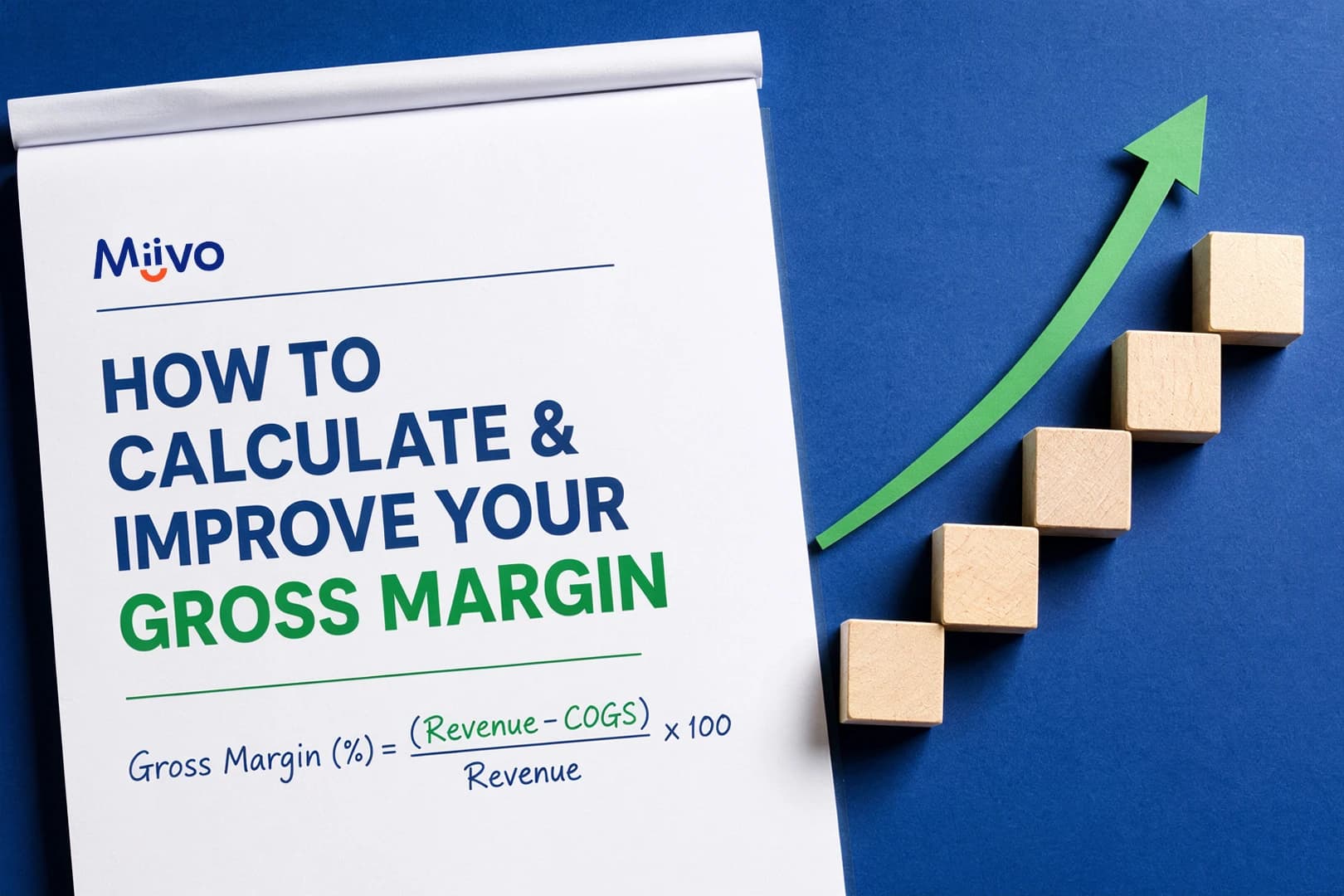
Gross margin is the percentage of revenue left after subtracting the direct costs of what you sold, calculated as (Revenue minus COGS) divided by Revenue, multiplied by 100. This page covers how to calculate it, how to define cost of goods sold correctly, the four things that move gross margin up or down, four ways to improve it without raising prices, and why blended margin hides the problem that product-level margin reveals.
Revenue tells you how much money came in. Gross margin tells you how much of it you kept after paying for what you sold. A restaurant doing $80,000 in monthly revenue sounds healthy until you learn that $30,400 went to food and beverage costs. Whether the resulting 62% is good depends on the business, the industry, and what it was last month. The number only becomes useful when you understand what drives it and how to move it.
What Is Gross Margin and Why Does It Matter More Than Revenue?
Gross margin is the percentage of revenue that remains after subtracting the direct cost of delivering the product or service. If a salon charges $120 for a treatment and the product cost is $18, the gross margin on that treatment is 85%.
Revenue is how much came in. Gross margin is how much of it the business kept before paying rent, staff, and everything else. A business that grows revenue while gross margin shrinks is getting busier without getting more profitable, which is why gross profit margin matters more than the top line.
Gross margin is not the same as net margin. Net margin accounts for every expense, including rent, payroll, marketing, and taxes. Gross margin isolates only the direct costs of production, which makes it the lever you can act on operationally.
Margin and markup are also different calculations. Margin is a percentage of revenue. Markup is a percentage of cost. Confusing the two leads to pricing errors: a 50% markup produces a 33% margin, not a 50% one.
How Do You Calculate Gross Margin for a Small Business?
Gross Margin (%) = (Revenue minus Cost of Goods Sold) / Revenue x 100
Cost of goods sold, or COGS, is the direct cost of what was sold. Here is how the formula applies to three common business types.
| Business Type | Monthly Revenue | COGS | Gross Margin |
| Restaurant | $80,000 | $30,400 | 62% |
| Salon | $45,000 | $6,750 | 85% |
| Retail shop | $60,000 | $33,000 | 45% |
The critical step is defining COGS correctly. Only include the direct cost of what was sold. Rent, payroll for non-production staff, and marketing are operating expenses, not COGS. For a restaurant, COGS includes food cost, beverage cost, and packaging. For a salon, it is the product cost per treatment. For a retail shop, it is the wholesale cost of goods. Including operating expenses in COGS is the most common gross margin calculation error in physical businesses.
Why Do Published Restaurant Gross Margins Look So Much Lower Than Yours?
Published benchmarks and operator calculations use different definitions of COGS, which is why the same restaurant can show a 62% gross margin and a 32% one.
This trips up more owners than any other benchmarking question, so it is worth being precise about.
● Operator convention. Revenue minus food and beverage cost only. With food cost running at the industry standard of 28% to 35% of revenue, this produces a gross margin of roughly 65% to 72%.
● Public-company convention. The COGS line in listed-company filings frequently absorbs kitchen labor and occupancy costs as well. According to *NYU Stern* data compiled by Aswath Damodaran in January 2026, the restaurant and dining sector shows an average gross margin of 32.24% on this basis.
Neither is wrong. They are answering different questions. The practical rule is to compare your margin against your own prior periods first, and against a published benchmark only when you know which definition that benchmark used.
For reference, the same NYU Stern dataset puts software at 71.72%, grocery and food retail at 26.31%, and the total market average at 37.76%.
What Drives Gross Margin Up or Down in a Physical Business?
Gross margin moves for four reasons.
● The cost of goods changes. Supplier prices rise, waste increases, or portions drift upward.
● The selling price changes. Discounts, promotions, or competitive pressure push revenue per unit down.
● The product mix shifts. Customers buy more of the low-margin items and fewer of the high-margin ones.
● Volume changes without a cost adjustment. A restaurant that orders the same amount of food on a slow week as a busy one pays for product that goes unused.
Each shows up as a margin change on the profit and loss statement, and the statement alone does not tell you which one caused it.
Food cost percentage is a reliable early warning signal for restaurants, and it is one of the numbers that business intelligence tools for restaurant owners are built to watch. When food cost percentage rises, gross margin falls. The same logic applies in a salon when product cost per treatment creeps up without a corresponding price adjustment. Supplier costs rarely announce themselves. They drift upward through small increases that compound over months, which is why a supplier invoice review is often the fastest way to find margin erosion that the blended number hid.
How Do You Improve Gross Margin Without Losing Customers?
Raising prices is the obvious answer and usually not the best one. Four other levers move margin without touching the price tag.
1. Shift the product mix toward higher-margin items
Promote, feature, and recommend the products or services with the highest margins. A restaurant that moves its highest-margin dish from page two to the top of the specials board sells more of it without changing a single price. The blended margin rises because the mix changed.
2. Renegotiate supplier costs
Get competing quotes and present them to current suppliers. Most will match or improve terms. A 3% reduction in food cost on a $30,000 monthly spend is $900 per month of margin improvement with no impact on the customer experience.
3. Reduce waste and spoilage
For restaurants, tighten portion control, improve prep accuracy, and order against actual demand rather than habit. For retail, improve stock rotation and mark down slow-moving items before they become dead stock. Every unit wasted is COGS with no revenue against it.
4. Review pricing on specific items, not across the board
Instead of raising all prices by 5%, identify the items where the business is underpriced relative to competitors or where demand is price-insensitive. A small adjustment on a high-volume item has a larger margin impact than a large adjustment on a low-volume one, and customers notice a blanket increase everywhere at once.
What Gross Margin Mistakes Do Small Businesses Make?
Most gross margin mistakes are not calculation errors. They are interpretation errors.
● Including operating expenses in COGS. Rent, admin salaries, and marketing are not COGS. Including them makes gross margin look worse than it is and hides the real cost-of-goods picture.
● Tracking only blended margin. A 62% blended margin can mask a 45% margin on the item that accounts for a third of sales. Without a product-level breakdown, the owner cannot see where to act.
● Ignoring margin when revenue is growing. Revenue growth feels positive. If gross margin is shrinking at the same time, the business is scaling a cost problem, and more revenue at lower margins does not always mean more profit.
● Treating margin as a yearly number instead of a trend. A single margin figure is a snapshot. Margin tracked monthly shows direction, and a margin that has dropped for three consecutive months is a pattern that needs investigation rather than a data point to review at year-end.
How Do Physical Businesses Track Gross Margin by Product, Location, and Time Period?
The gap for most physical businesses is that margin lives in the accounting software as a single blended number, while the data needed to break it down by product, location, and period lives in the point-of-sale system. A restaurant owner who wants to know which menu items carry the margin and which drag the average down has to match POS sales data to supplier invoices by hand, and most do not have the time.
Miivo’s AI Business Dashboard connects the financial data from accounting and the sales data from the point-of-sale automatically, showing gross margin by product, by location, and by period without the manual spreadsheet build.
Which Financial Metrics Should You Track Alongside Gross Margin?
Gross margin is one of the core financial metrics a business owner must track, sitting alongside revenue growth rate, net profit margin, operating cash flow, and the break-even point.
How Do You Set Up Budget vs Actual Tracking for Margin Targets?
Once you know your gross margin, the next step is setting a target and comparing actual performance against it monthly. Budget vs actual tracking surfaces a drifting food cost percentage as a variance rather than a year-end surprise.
Frequently Asked Questions
What is a good gross margin for a small business?
A good gross margin depends on the industry and on which COGS definition is being used. On the operator convention of revenue minus food and beverage cost, restaurants typically run 65% to 72%, salons 60% to 80%, and retail shops 25% to 50%. On the public-company convention used by NYU Stern data, the restaurant sector averages 32.24% and the total market averages 37.76%. Compare against your own prior periods first.
What is the difference between gross margin and profit margin?
Gross margin measures the percentage of revenue left after subtracting only the direct costs of producing or delivering the product. Net profit margin subtracts all expenses, including rent, staff, taxes, and interest. Gross margin shows how efficiently a business produces its goods or services. Net profit margin shows how efficiently it runs the whole operation.
What should I include in COGS for my restaurant?
Restaurant COGS includes food cost, beverage cost, and packaging. It does not include rent, marketing, or wages for admin staff. Only the direct cost of what was sold counts. Including operating expenses in COGS is the most common gross margin calculation mistake in physical businesses.
Why is my gross margin falling even though I have not raised prices?
Falling gross margin without a price change usually signals one of three things: supplier costs have increased, waste or spoilage has increased, or the product mix has shifted toward lower-margin items. Tracking margin by product and by period identifies which driver is responsible.
How often should a small business calculate gross margin?
Monthly at a minimum. Monthly tracking reveals trends that annual or quarterly reviews miss. A margin that drops for three consecutive months is a pattern worth investigating, while a one-month dip may reflect a seasonal shift or a short-term cost increase.
Can I improve gross margin without raising prices?
Yes. The four levers are adjusting the product mix toward higher-margin items, renegotiating supplier costs, reducing waste and spoilage, and selectively adjusting pricing on specific high-volume items rather than applying blanket increases. Product mix and waste reduction often deliver faster results than price changes.
What is the difference between margin and markup?
Margin is calculated as a percentage of revenue and markup as a percentage of cost. An item costing $50 and selling for $75 carries a 50% markup and a 33% margin. Treating the two as interchangeable is a common source of underpricing.
Book a Consultation With Miivo
Calculating a blended gross margin takes a few minutes. Splitting it by product, location, and period is what tells you where the margin is actually going, and that is the part that requires matching point-of-sale data to supplier invoices every month. Miivo connects those systems so the split is already done and current. A dedicated account manager reviews it with you every week.
Connect the tools you already use. Go live within five days.
[Book a call] [Start for free]
*No credit card required