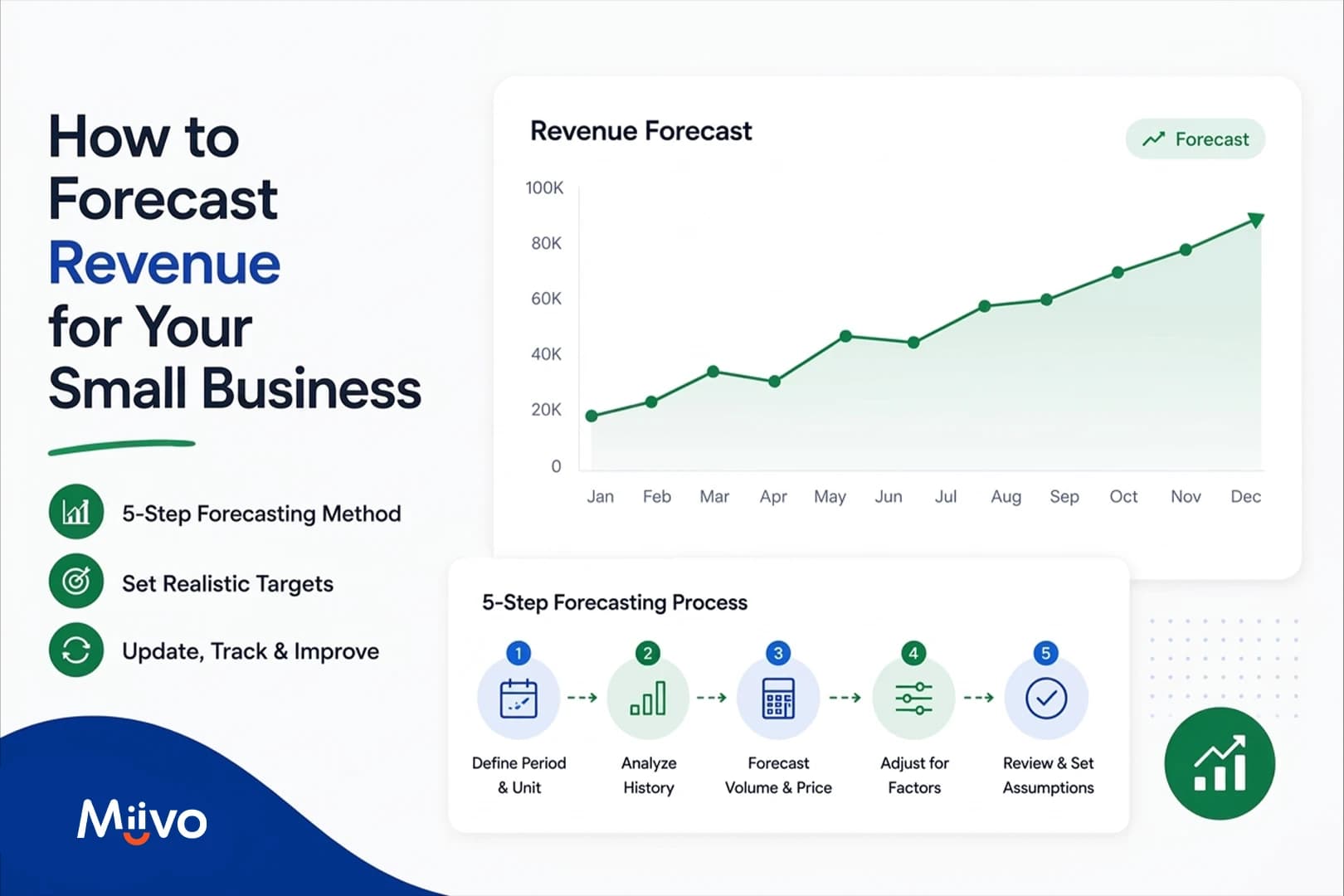
A revenue forecast is an estimate of what your business will sell over a set period, built from how many customers or units you expect and what each one is worth. This page covers what a forecast is for, a five-step method to build one, how accurate it needs to be, how often to update it, and the mistakes that break most small business revenue forecasts.
Most small business owners know they should forecast revenue. Few do it in a way that holds up past January. The process is not complicated, and it only requires two honest numbers: how many you expect to sell, and what each sale is worth on average.
What Is a Revenue Forecast, and What Is It Actually For?
A revenue forecast is an estimate of the sales you expect to earn over a set period, usually the next 12 months. Most owners build one, file it away, and forget it exists.
The owners who get real use from a forecast treat it as a working tool. A forecast helps you decide the following.
● Whether you can afford a new hire before you commit.
● When to place a stock or equipment order.
● What target to give your team and hold them to.
● Whether your numbers will support a loan or lease application.
One distinction matters more than any other. A revenue forecast is not a cash flow forecast; revenue is counted when the sale is earned, while cash is counted when the money lands in your account. An invoice raised in March sits in your March revenue even if the customer pays in May, which means a business can hit its revenue forecast and still be short of cash. Seeing revenue and business cash flow side by side is what keeps the two from being confused.
How Do You Forecast Revenue in Five Steps?
The method is the same whether the business sells coffee, haircuts, or consulting hours. It comes down to two numbers: how many you expect to sell and what each one is worth on average.
| Step | What You Do | What You Need | Where It Comes From |
| 1 | Choose your forecast period and unit of sale | A defined time window and a countable unit | Your business model |
| 2 | Start from your own history, not a growth target | Last 12 months of sales by month | POS or accounting software |
| 3 | Build the forecast bottom up, volume times price | Expected volume and average sale value per category | Sales records, pricing |
| 4 | Adjust for seasonality, price changes, and what is booked | Seasonal shape, scheduled price changes, contracts | Last year’s data, signed agreements |
| 5 | Sense check it from the top down, then write your assumptions down | Market size or prior year total, a justifiable growth rate | Industry data, your own judgment |
Step 1: Choose Your Forecast Period and Your Unit of Sale
The period, usually 12 months, broken into individual months, is the standard for a small business. That window is long enough to plan a hire or a lease and short enough to stay honest.
The unit of sale is the specific thing you count. A restaurant counts covers. A salon counts appointments. A retailer counts orders. A service business counts client months. SCORE advises keeping the forecast to fewer than ten sales categories, and that is a sensible ceiling for most small businesses.
If you cannot name your unit of sale, you cannot forecast, you can only guess.
Step 2: Start From Your Own History, Not From a Growth Target
Pull the last 12 months of sales by month from your point-of-sale or accounting software. That shape becomes your baseline. A simple run rate gives a defensible first estimate for next month: average the last three months of actual sales and carry that number forward. The same baseline logic underpins any step-by-step forecast of business growth.
Most bad forecasts begin with the number the owner wants to hit, then work backwards to justify it. A target is not a forecast, and the two belong in separate columns.
If the business is new and has no history, use supplier or franchise benchmarks, data from a comparable local business, or your first eight weeks of trading annualized with caution. Checking which KPIs a small business should track first is worth doing before the forecast, not after.
Step 3: Build the Forecast Bottom Up, Volume Times Price
Expected volume multiplied by average sale value equals forecast revenue, calculated per category and then added together.
See the example below for a small service business with two revenue categories.
| Category | Expected Volume | Average Sale Value | Monthly Revenue | Annual Revenue |
| Single sessions | 80 bookings | $65 | $5,200 | $62,400 |
| Monthly retainers | 12 clients | $300 | $3,600 | $43,200 |
| Total | $8,800 | $105,600 |
Every input in that table is a number you can check against reality. When the forecast turns out wrong, you can see immediately if volume or average sale value moved. A percentage growth assumption tells you nothing useful when it misses.
Step 4: Adjust for Seasonality, Price Changes, and What Is Already Booked
The following adjustments turn a generic forecast into your forecast.
- Seasonality: Apply the month-by-month shape from last year rather than dividing the annual total by twelve. A florist in February, a gym in January, and a retailer in November each have peaks that a flat monthly split will miss. For a seasonal business, this step is where the most money gets lost on paper.
- Price and cost changes: A price increase you have already scheduled belongs in the forecast from the month it takes effect. A supplier cost increase that will force your prices up also belongs in the numbers, even if you have not announced it yet.
- Known commitments: Contracts signed, bookings confirmed, and deposits received are the most reliable revenue in the whole forecast. Count them first and keep them in a separate column from the estimated part.
Step 5: Sense Check It From the Top Down, Then Write Your Assumptions Down
The top-down sense check: Compare the bottom-up total against something external, like your market size and a realistic share of it, or last year’s revenue plus a growth rate you can honestly justify. If the two numbers are far apart, one of them is wrong, and it is usually the volume assumption.
The assumptions log: Write down every number you assumed and why, in one place. A forecast without its assumptions cannot be corrected later. It can only be rewritten.
How Accurate Should a Small Business Revenue Forecast Be?
Landing within about 10% of actual revenue over a month is a good forecast for most small businesses, and within 5% is very good. Treat these as working rules of thumb, not published benchmarks.
The monthly check takes one line: put forecast next to actual, calculate the gap as a percentage, and note whether the error came from volume or from average sale value.
The purpose of a forecast is not to be right. The purpose is to be wrong in a way you can see early and correct, which is what an AI early warning system does when it flags the gap the week it opens. A 12% miss that traces back to one category running low on volume is useful information.
How Often Should You Update Your Revenue Forecast?
Update monthly for most small businesses, and weekly if the business is seasonal, fast-moving, or in a growth push.
A rolling forecast keeps the next 12 months always in view. Each time a month closes, add a new month to the end so the horizon never shrinks to nothing by December. Both Wall Street Prep and PayPal describe the same logic, with monthly or weekly updates for fast-moving businesses and quarterly for steady ones.
One practical condition applies. The update is only worth doing if the actuals are already in front of you, which is why the data small business owners should review weekly matters more than the forecast template itself. Otherwise the hour goes on gathering numbers rather than making decisions.
What Data Do You Need Before You Can Forecast Revenue?
Five inputs are required before you can build a small business revenue forecast.
● 12 months of sales by month
● Sales split by category or product line
● Average sale value per category
● Customer or order counts by period
● Contracts, bookings, and deposits already confirmed
Those inputs usually live across four or five separate systems: the point-of-sale, the accounting software, the booking system, and at least one spreadsheet.
For most owners, building the forecast is not the hard part, keeping it current is. Rebuilding the inputs by hand every month is what quietly kills a forecast by month three.
What Are the Most Common Revenue Forecasting Mistakes?
The most common revenue forecasting mistakes are given below.
- Forecasting the target instead of the business: Goal-led forecasting is the most commonly named error among small business finance advisors. Put the target in a separate column and build the forecast from actual inputs.
- Dividing the annual number by twelve: This ignores seasonality and produces a flat line that is wrong every month. Use the month-by-month shape from last year.
- Treating revenue as cash: A business can hit its revenue forecast and still be short of cash if customers pay late. Run a cash flow forecast alongside the revenue forecast.
- Never comparing forecast against actual: The same error repeats all year with no correction. Put the two numbers next to each other every month and trace the gap to its source.
- Building it once in January and never opening it again: A forecast you never check is a wish with a spreadsheet around it. Schedule a monthly update and keep a rolling 12-month window.
The five inputs above are exactly the data that sits scattered across the point-of-sale, the accounting software, and the booking system. Assembling them once is manageable. Assembling them every month is what stops the process by month three.
Miivo’s AI Business Dashboard connects those systems so sales history, categories, and average sale values stay live, and flags the gap between forecast and actual the week it opens, not at month-end.
Frequently Asked Questions About Revenue Forecasting
What is the formula for forecasting revenue?
Expected volume multiplied by average sale value, worked out per category and added together. Everything else in revenue forecasting is an adjustment to those two numbers.
How far ahead should a small business forecast revenue?
Twelve months, broken into months, updated monthly so the horizon keeps rolling forward. Anything beyond about a year becomes planning rather than forecasting.
How do you forecast revenue for a brand new business?
Build it bottom up from capacity: how many customers you can physically serve in a week, multiplied by a realistic average sale, multiplied by the weeks you will trade. Then check it against a comparable local business.
Is a revenue forecast the same as a cash flow forecast?
No, revenue is counted when the sale is earned and cash is counted when the payment lands. A business can hit its revenue forecast and still be short of cash if customers pay late.
How accurate should a small business revenue forecast be?
Within about 10% of actual revenue over a month is good and within 5% is very good. These are working rules of thumb rather than published benchmarks. What matters more than the size of the miss is whether you can trace it to volume or to average sale value.
Book a Consultation With Miivo
Miivo connects the tools you already use, so your sales history, categories, and average values stay live without manual rebuilding. A dedicated account manager reviews the numbers with you every week.
Connect the tools you already use. Go live within five days.
[Book a call] [Start for free]
*No credit card required