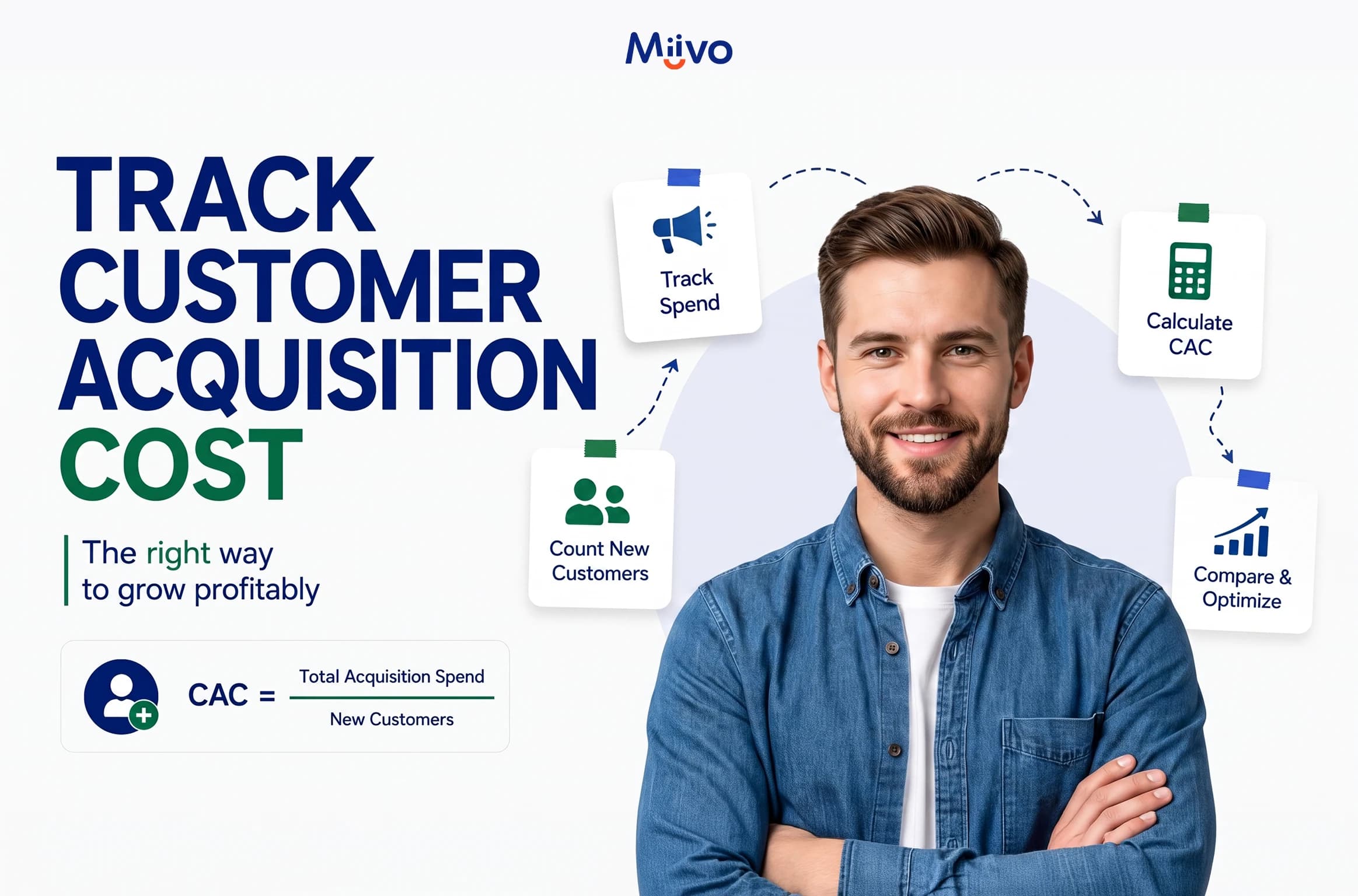
The standard advice on customer acquisition cost is to divide marketing spend by new customers acquired. For a software company with a record of where every signup came from, that works. For a restaurant where most people walk in, a salon where the best clients arrive through friends, and a gym where January is January, the formula is fine and the data is missing. The number is still worth having. Getting to it takes a different route.
What Is Customer Acquisition Cost and What Counts as a Cost?
Customer acquisition cost is the total amount spent to bring in one new customer over a given period. The formula is straightforward. Total acquisition spend divided by the number of new customers acquired in the same period. What makes the number wrong in most small businesses is not the arithmetic. It is what gets left out of the top half.
Include each of the following in the numerator:
● Advertising and boosted posts: Any paid placement, digital or print, run to attract new customers
● Discounts and introductory offers given specifically to new customers: A first-visit discount is acquisition spend, not a price adjustment
● Listing, platform, and directory fees: Google Business, Yelp, booking platform charges, and any similar fee
● Agency, freelancer, and design costs: Any outside help producing marketing material
● Events, sponsorship, and printed material: Flyers, local sponsorships, and anything produced to drive awareness
● The share of any salary spent on marketing work: Including your own time, if it is significant
Leave out marketing directed at existing customers. A promotion sent to your mailing list is retention spend. Including it inflates acquisition cost while hiding the fact that retention is usually the cheaper of the two.
How Do You Calculate CAC When You Cannot Track Where Customers Come From?
Blended acquisition cost divides all acquisition spend by all new customers, without asking where any of them came from. It is always calculable, it is honest about what is known, and it is the right default for a business with walk-in trade.
The harder part is counting new customers. Four methods work for physical businesses:
First-time bookings: For salons, clinics, and anything appointment-based, the booking system already knows. A client record created this month with no prior appointment is a new customer. No extra process is required.
Loyalty or rewards enrollment: Enrollments are a reliable proxy if the program is offered consistently at the point of sale. Estimate the share of customers who enroll, scale up accordingly, and state the estimate openly when you report the number.
First-time card use: Many point-of-sale systems can identify a card that has not been used at the business before. This is the strongest available proxy for a walk-in business, and it is often already in the data.
Direct count for account-based businesses: Gyms, subscription services, and anything with a membership have an exact count. New memberships in the period, with cancellations excluded rather than netted off.
Once new customers are counted, the calculation is direct:
| Item | Amount |
| Local advertising | $2,400 |
| Introductory offers to new clients | $1,850 |
| Booking platform listing fee | $600 |
| Social media freelancer | $1,500 |
| Total acquisition spend | $6,350 |
| New clients (first-time bookings in the quarter) | 127 |
| Blended acquisition cost | $50 per new client |
Fifty dollars is not good or bad on its own. The number becomes meaningful only against what a client is worth, which the next section covers.
What Is a Good CAC and How Do You Judge Yours?
There is no useful universal answer. An acquisition cost is judged against two things: what a customer is worth to you, and how long it takes to earn the cost back.
Compare against customer value. Work out what a customer is worth over their relationship with the business. Average spend per visit, multiplied by visits per year, multiplied by the number of years they typically stay, multiplied by gross margin. A salon client spending eighty dollars, visiting six times a year, staying three years, at a sixty percent margin, is worth around eight hundred and sixty dollars in gross profit. Against that, a fifty dollar acquisition cost is comfortable. The commonly cited guideline is that customer lifetime value should be at least three times acquisition cost. Treat that as a reasonable floor, not a target to optimize toward.
Compare against payback period. Count how many visits or how many months it takes to recover the fifty dollars in gross profit. In the example above, the first visit alone returns forty-eight dollars of margin, so the cost is recovered inside two visits. For a business with tight cash, payback period matters more than the ratio, because a customer who is profitable over three years and unprofitable for the first six months still has to be funded.
A note on published benchmarks. Published averages are of limited use at this scale. The most credible current figure comes from Shopify’s 2026 Global Commerce Report, which found acquisition cost across 4.8 million merchants rising from $274 to $318, an increase of 16.1 percent. That is e-commerce data, and the direction is more useful than the level. Acquisition is getting more expensive almost everywhere, which raises the value of retention.
How Do You Track CAC by Channel When Some Channels Are Untrackable?
Full channel attribution is not available to a physical business, and pretending otherwise produces confident nonsense. Four methods give partial evidence, which is enough to make decisions.
1. Ask at the point of sale or booking. One question, asked consistently: how did you hear about us? Record the answer as a field in the booking system or as a button on the point-of-sale screen. The data is imperfect because people misremember and staff forget to ask, but across a few hundred responses the pattern is real and it costs nothing.
2. Unique offer codes per channel. Assign a different code or offer to each channel, redeemed at the till or at booking. This undercounts, because only some customers use the code, but it produces a floor for each channel that can be compared against the others on the same basis.
3. Holdout tests. Turn a channel off for a defined period, or run it in one location and not another, and compare new customer counts. This is the only method here that measures whether the spend caused the customers rather than merely accompanied them. Run it for at least four weeks, and compare against the same period last year to control for seasonality.
4. Capture the source at first visit only. Ask once, on the first booking or first loyalty enrollment, and store the answer against the customer record. This turns a one-off response into a lasting attribution that also lets you compare the value of customers by source, not just the cost of acquiring them.
What Are the Most Common CAC Mistakes Small Businesses Make?
Five mistakes turn a useful number into a misleading one.
● Counting advertising only. Discounts to new customers, listing fees, and marketing time are all acquisition spend. Leaving them out can halve the apparent cost and lead to spending decisions that do not hold up.
● Counting all customers instead of new ones. Dividing spend by total customers served produces a small, comforting number that measures nothing. The denominator has to be new customers only.
● Mismatching the periods. Money spent in March often brings customers in April. Use a rolling three-month window rather than a single month, particularly in businesses with a booking lead time.
● Judging the number against an industry average. Published averages come from different business models with different customer values. Your own repeat rate and margin are the only comparison that means anything.
● Optimizing acquisition cost while ignoring retention. Halving acquisition cost is difficult. Adding one visit a year per existing customer is usually easier and worth more, and it improves the acquisition cost ratio at the same time.
How Do Physical Businesses Track Acquisition Cost Across Marketing, POS, and Booking Data?
Calculating acquisition cost once is straightforward. Keeping it measured every month is where it stops happening, because the spend sits in the accounting file, the new client count sits in the booking system, and the first-time card data sits in the point of sale. Miivo connects those systems, so acquisition spend and new customer counts land in the same place and the AI Business Dashboard reports blended acquisition cost alongside average spend and repeat rate, which are the two numbers that decide whether the cost is worth paying.
Which KPIs Should a Small Business Track?
Acquisition cost is one number among a small set that matters. A small business’s KPIs include the repeat rate and average spend figures that decide whether an acquisition cost is worth paying.
What Financial Metrics Matter Most for Small Business Growth?
Acquisition cost only makes sense next to margin. The financial metrics that matter most for small business growth include the gross margin figure that turns a customer’s spending into what they are actually worth.
Book a Consultation
If you want acquisition cost measured every month from your own spend and booking data rather than reconstructed once a year, book a free consultation with the Miivo team.
[Book a call] [Start for free]
*No credit card required