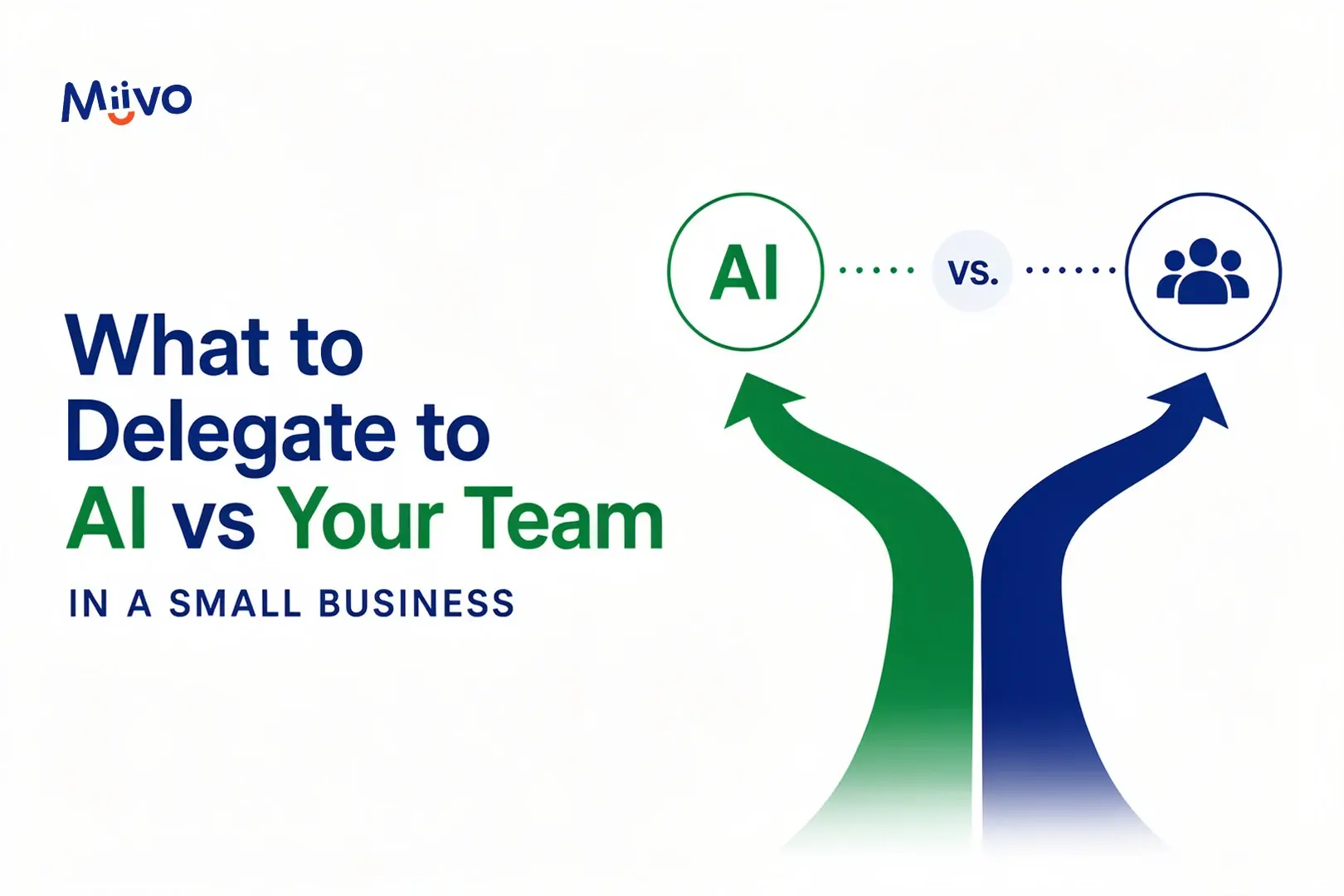
Delegate data-driven, repetitive tasks to AI and keep relationship-driven, judgment-based tasks with your team. Financial reporting, scheduling, review monitoring, inventory signals, and competitor tracking belong to AI. Customer service recovery, complex decisions, team leadership, and creative work belong to people. This page covers both lists, a three-question test for classifying any task, and the delegation mistakes that cost small businesses customers.
AI tools are cheaper, faster, and more accessible than they have ever been. A small business that hands the wrong tasks to AI ends up with impersonal customer interactions, unchecked errors, and tools nobody uses. A small business that ignores AI entirely spends hours on work a tool could handle in minutes. The question is not whether to use AI. The question is which tasks to give it and which to protect.
Why Is AI Delegation a Decision Small Business Owners Need to Make Now?
AI adoption among small businesses has moved from marginal to majority in under three years, which makes the delegation decision current rather than theoretical. According to the *U.S. Chamber of Commerce* Empowering Small Business report, which surveyed 3,870 small businesses in June 2025, 58% now use generative AI, up from 40% in 2024 and roughly 23% in 2023. The Chamber called it the fastest technology uptake it has tracked since social media.
Getting the decision wrong runs in both directions. Automate a customer-facing task and you lose the personal quality that differentiates your business. Refuse to automate a data task and you waste hours your team could spend on customers.
Which Tasks Should a Small Business Delegate to AI?
AI performs best on tasks that involve processing data, following rules, and doing the same thing consistently at scale.
1. Financial reporting and data processing
Pulling numbers from the point-of-sale, accounting software, and bank accounts into a single report. Categorizing expenses. Tracking revenue against budget. Generating weekly financial summaries. All data processing, all rule-based, all repetitive, and all handled by automated business reporting software without a person assembling anything.
2. Scheduling and reminders
Appointment reminders, shift scheduling based on demand patterns, and follow-up messages for no-shows. These tasks are triggered by data and follow a consistent process.
3. Review and reputation monitoring
Scanning new reviews across platforms, flagging negative ones, and summarizing sentiment trends over time. AI can read 200 reviews and tell you what changed this month. A person doing the same task takes hours.
4. Inventory and ordering signals
Flagging when stock levels fall below threshold, identifying ordering patterns, and surfacing waste. The data already exists in the point-of-sale and supplier systems, and AI connects it and surfaces what needs attention.
5. Competitor monitoring
Tracking competitor pricing changes, new menu items, and review trends. This is data collection and comparison, which is exactly what AI does well.
Which Tasks Should Stay with Your Human Team?
Your team is irreplaceable for tasks that involve trust, empathy, judgment, and the personal connection that keeps customers coming back.
1. Customer relationships and service recovery
A customer who had a bad experience needs a person, not a chatbot. Handling complaints, making things right, and building loyalty require empathy, tone, and judgment that AI cannot replicate.
2. Complex business decisions
Whether to open a second location, how to handle a staffing conflict, whether to invest in a new product line. These decisions require business context, risk tolerance, and values. AI can supply the data. The decision itself stays human.
3. Team leadership and culture
Motivating staff, giving feedback, resolving interpersonal issues, and building a team culture are relationship tasks requiring presence, emotional intelligence, and trust. No AI tool can lead a team.
4. Creative and strategic work
Designing a new menu, planning a marketing campaign, or reimagining the customer experience requires taste, intuition, and an understanding of the local market that AI does not have.
How Do You Decide Whether a Task Goes to AI or Your Team?
For any task, ask these three questions. The answers tell you where the task belongs.
Question 1: Is the task data-driven or relationship-driven?
If the task involves processing, comparing, or reporting data, AI handles it. If it involves building trust, reading emotions, or having a conversation that matters, it stays with a person. Financial reporting is data-driven. Handling a customer complaint is relationship-driven.
Question 2: Is it repetitive, or does it require fresh judgment each time?
If the task follows the same steps every time, AI does it consistently and without fatigue. If each instance requires a different decision based on context, a person needs to be in the loop. Sending appointment reminders is repetitive. Deciding whether to honor an unusual refund request is judgment.
Question 3: If AI makes a mistake, is it a process problem or a trust problem?
A mistake in a financial report is a process problem that can be caught and corrected. A mistake in a customer interaction is a trust problem that can lose a customer permanently. Assign AI where mistakes are fixable, and keep people where mistakes are costly to the relationship.
What AI Delegation Mistakes Do Small Businesses Make?
Most AI delegation mistakes come from misunderstanding what AI is actually good at.
● Automating customer-facing interactions that need a personal touch: A chatbot that handles appointment booking is helpful. A chatbot that handles a customer complaint is damaging. The line between the two is whether the customer expects to be heard or simply processed.
● Delegating to AI without checking the output: AI is consistent but not always correct. Financial reports, content generation, and data analysis all need a human review step. Trust but verify applies to AI output the same way it applies to a new employee.
● Trying to automate everything at once: Start with one or two high-volume, low-risk tasks, get comfortable, then expand. A business that rolls out five AI tools in the same month overwhelms the team and has no way to measure what is working. Sequencing matters more than speed when you integrate AI with a business.
● Choosing an AI tool without understanding the task: The tool is not the starting point. The task is. Define what the task involves, whether it is data-driven or relationship-driven, and what a good outcome looks like, then choose the tool that fits.
How Does a Physical Business Use AI for Data and Humans for Decisions?
The framework plays out directly in how physical businesses handle their financial and operational data. Pulling numbers from the point-of-sale, tracking revenue against budget, monitoring costs, and comparing performance across locations is repetitive, data-driven work that AI handles well. Deciding what to do when costs spike, which location needs attention, and whether to adjust pricing or staffing is judgment work that stays with the owner and their team.
Miivo’s AI Business Dashboard handles the data layer automatically, connecting financial and operational systems and surfacing what has changed as AI Warning Signals and Opportunity Cards. A dedicated Miivo account manager then reviews those signals with the owner every week, so the interpretation stays human.
What Is an AI Business Advisor and How Does It Work?
An AI business advisor goes a step beyond tools that only process data, interpreting patterns and surfacing recommendations for a person to act on. The human still sits in the loop, and the advisor changes what that person is deciding rather than whether they decide.
What Does a Business Dashboard Show When AI Handles the Data?
When AI handles the data processing, the result is a business dashboard that updates without anyone assembling it, so the weekly review starts with the numbers already gathered rather than an hour of manual work.
Frequently Asked Questions
What is the simplest way to decide which tasks to delegate to AI?
Ask two questions. First, is the task data-driven or relationship-driven? Second, does it follow the same process every time, or does it require fresh judgment? Data tasks that repeat on a schedule are strong candidates for AI. Relationship tasks requiring empathy or context stay with your team.
Can AI handle customer service for a small business?
AI handles transactional customer service well, including booking confirmations, appointment reminders, and answers to common questions. AI should not handle service recovery or complaints, because those interactions require empathy and judgment. A customer who feels unheard by a chatbot is more likely to leave than one who speaks to a person.
What are the most common AI tasks for a small restaurant or salon?
Financial reporting, scheduling, appointment reminders, review monitoring, and inventory signals are the highest-value starting points. According to Business.com, marketing content creation (68%), customer communication (52%), and administrative tasks (47%) are the three most common AI applications among small businesses generally.
How much time can a small business owner save by delegating tasks to AI?
According to Business.com, the average small business saves 5.6 hours per week using AI, and owners and managers save more than seven. Bluevine research puts it more conservatively, with 48% of small businesses using AI saving at least four hours per week. The actual figure depends on which tasks are automated and how consistently the tools are used.
What happens if an AI tool makes a mistake?
The answer depends on the task. A mistake in a financial report is a process problem that can be identified and corrected before it causes damage. A mistake in a customer interaction is a trust problem that can permanently affect the relationship. Assign AI to tasks where errors are recoverable.
Does using AI mean replacing team members?
No. According to the U.S. Chamber of Commerce, 82% of small businesses that use AI increased their workforce over the prior year. AI takes over data tasks so the team can spend more time on the relationship and judgment work that drives customer loyalty and growth, which is the practical route by which AI enhances the productivity of a small business.
Book a Consultation With Miivo
The framework is simple to state and harder to apply, because the data tasks worth delegating are spread across the point-of-sale, the accounting software, and the review platforms. Miivo takes that whole layer off your team, connects the tools you already use, and surfaces what changed. The judgment stays with you, and a dedicated account manager works through it with you every week.
Connect the tools you already use. Go live within five days.
[Book a call] [Start for free]
*No credit card required